
 Log In


October 21, 2013
 Offline


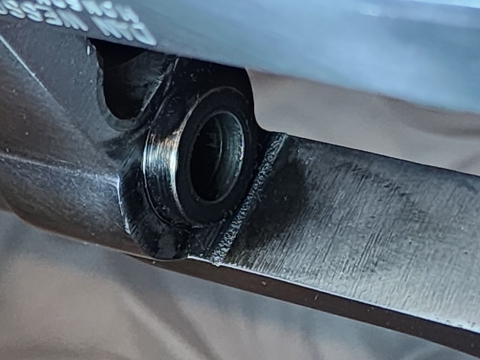
Thanks for the information guys. Looks like I have another item to save on my ebay search list. I finally got to pick my gun up from cabelas so here's what my top strap looks like. For all the pics see my other thread.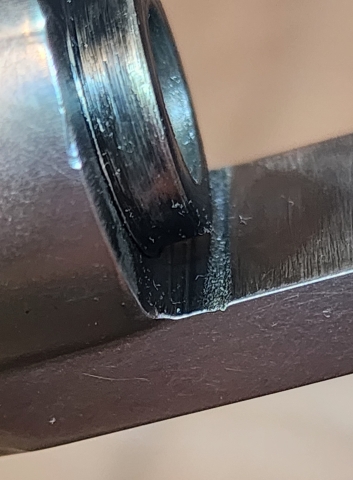


Supporter

Dans Club
March 25, 2013
Offline
That is very little flame cutting. Nothing to worry about. IMHO.
August 28, 2009
Offline

Here is some additional AI info. on this (which any of you can find as well). Sierra has limited their exposure to this by recommending and providing reloading data for 170+ gr. bullets. Dan Wesson acknowledged the problem in the lighter bullets (110 - 125 gr) and continued to supply their branded ammunition in the 158 gr and heavier weight up until about 8 years ago when they stopped supplying all ammunition all together in all calibers.
https://sierrabullets.com/content/load-data/handgun/357/357-Remington-Maximum.pdf
- Definition: Flame cutting (also called topstrap cutting or gas cutting) is the erosion of a revolver's topstrap directly above the cylinder-to-barrel gap. It is caused by high-velocity, high-temperature jets of unburned or burning powder gas and hot plasma jetting out of the gap the moment the bullet crosses from the cylinder into the barrel. [1, 2, 3]
- The Problem in Revolvers: When paired with lighter bullets (especially 110gr–125gr), the bullet cleared the cylinder gap too quickly while a massive charge of slow powder was still actively burning at extreme pressure. This acted like a cutting torch on the steel topstrap and rapidly eroded the barrel's forcing cone. [1, 2]
- Mitigation: Reloaders discovered that the issue was heavily exacerbated by light bullets; using heavier bullets (170 grains to 200 grains) kept the bullet in the case longer, built proper pressure, and largely mitigated excessive cutting. [1]
Dans Club
December 7, 2020
Offline
DakotaJack said
.....The Problem in Revolvers: When paired with lighter bullets (especially 110gr–125gr), the bullet cleared the cylinder gap too quickly while a massive charge of slow powder was still actively burning at extreme pressure. This acted like a cutting torch on the steel top strap and rapidly eroded the barrel's forcing cone......
Good information! I thought the 158gr bulletswere also part of the problem?
I have a lot of those Remington 158gr that I haven't fired since fearing the flame cutting was made known to me.
Dans Club
December 7, 2020
Offline
If you are looking for an ultra-high-temperature material rated up to 5,000°F (2,760°C), you need specialized inorganic ceramic adhesives, refractory coatings, or furnace cements (e.g., Aremco / Cotronics)
Or instead of the blast shield and an adhesive, a High Temp Refractory Coatings (e.g., ITC-100 HT):
- Products like ITC-100 HT Ceramic Refractory Coating are rated up to 5,000°F.
- Note: This is technically a high-emissivity ceramic coating/refractory protector for forges, kilns, and furnace linings rather than a structural glue.
-----------------------------------------------------------------------------------------------------------------------------------------------------------------------------
- The blast shield being for S&W is contoured for the smaller distance between barrel and top strap. So, although the DW barrel helps with alignment, it does not take an active part as a retaining system as the S&W is designed to do. So, an adhesive or a weld would be needed. I do not know what the weld and grinding of excess weld would do the the frame integrity.
- This may be a $$$ solution to a non-problem for DWs. It may be a solution for those that still have their Blackhawk .357 MAXIMUMS. Or, it may be no solution at all?


1 Guest(s)
