


 Register
 Log In


DWF Supporters
July 12, 2020
 Offline

Ole Dog knew that off the top of his head, he don't need any stinkin' registry!!! LOL


Dans Club
February 24, 2013
Offline
Don Lancaster said
I am new here, I was gifted from my grandfather a .357 Dan Wesson. Â
 To the
 from central IL!!
Dans Club
February 24, 2013
Offline
Ihorvath54 said
Hi everyone. I'm new to the forum. Â
To thefrom central IL!!

July 5, 2026
Offline

Dear all,
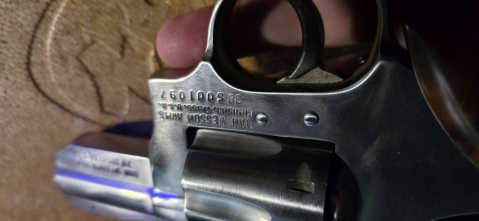
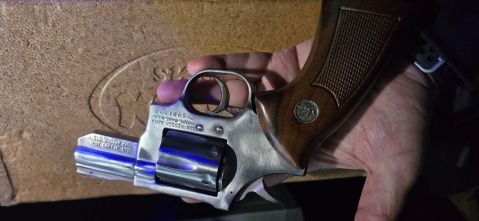
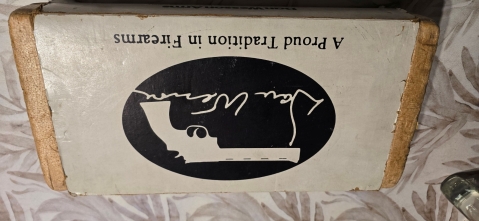
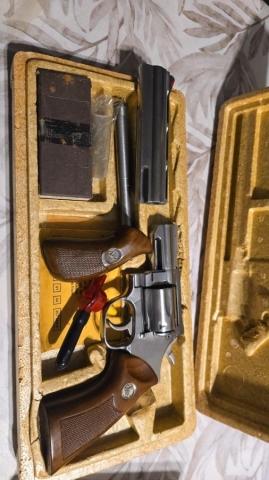
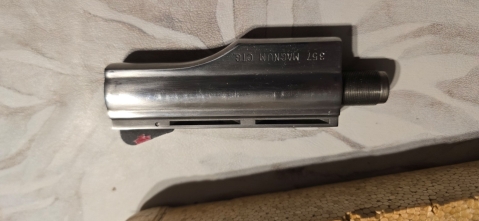
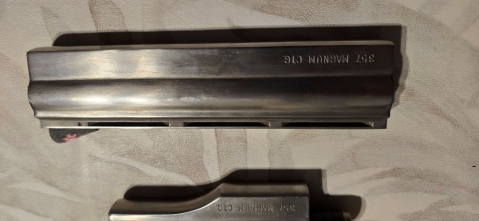
I recently acquired this Dan Wesson revolver, but I'd like to know if it's actually a .38 or a .357. My question arises because it came with three barrels, one of which is .38, but the other two are .357. Even next to the revolver's serial number, it has the number .38 stamped on it. However, I know that for legal reasons, where this revolver was imported from, .357s weren't permitted, so they were imported with .38 barrels and marked as .38 as well.
But in this case, I'm not sure if that's really the case or if it's a .38. Is it possible to obtain more information?
I will really appreciate your information
Diego
EDIT: Sorry the picture order, I don't know hoy to handle the direction


February 16, 2016
Offline
Looks like a Model 14-2 (.357 magnum) to me, but who knows what was done to make it .38 Special only for import legalities.
Will a .357 Magnum round fit in the cylinder without the bullet sticking out the front ?
October 18, 2017
Offline
If the cylinder will chamber a .357 round then the revolver is a .357 Magnum.

Supporter
Dans Club
March 25, 2013
Offline
As Stinger said, it is a fixed sight 14-2 . Unless it is chambered for 38 Special,in which case it is a Model 8-2. The bore of a 357 Mag and a 38 Special are the same. The two longer barrels are for a 15-2 357 Mag. The front sights are too high to shoot to point of aim unless you replace the interchangable front sights or mill them down. If it won't chamber 357 you can have the cylinder chambers reamed to accommodate 357. The frame ,cylinder, and barrel are the same as a 357. The only difference is the chambers.

Supporter

Moderators
Dans Club
February 22, 2009
Offline
The serial number indicates it's a 708 (38S____ and fixed sights) but if the chamber allows the longer .357 cartridge, some of the value of originality is gone. The stainless 38 took me the longest time to find and I watched diligently for many years before I found one. Let us know about the chamber!
Technically, the glass is always full; half liquid, half air....
February 16, 2016
Offline
rwsem said
The serial number indicates it's a 708 (38S____ and fixed sights)
Good catch .. I missed the 'S' in the S/N.
July 5, 2026
Offline
Dear all, thank you for all the answers!
I will answer all the questions that came up, for which I was able to find an answer.
Stinger said
Looks like a Model 14-2 (.357 magnum) to me, but who knows what was done to make it .38 Special only for import legalities.
Will a .357 Magnum round fit in the cylinder without the bullet sticking out the front ?
I got .357 ammo and when I put it in the cylinder some of it remained outside, so no, the chamber isn't for .357.
Ole Dog said
As Stinger said, it is a fixed sight 14-2 . Unless it is chambered for 38 Special,in which case it is a Model 8-2. The bore of a 357 Mag and a 38 Special are the same. The two longer barrels are for a 15-2 357 Mag. The front sights are too high to shoot to point of aim unless you replace the interchangable front sights or mill them down. If it won't chamber 357 you can have the cylinder chambers reamed to accommodate 357. The frame ,cylinder, and barrel are the same as a 357. The only difference is the chambers.
You are totally right, When I tried using the 6" barrel, which is .357 caliber, all the shots went low, so the sights are too high. Do you know if they can be changed? Where could I buy them?
I've also noticed that when I screw on the barrel, I position the locking mechanism so it makes contact with the cylinder, then I put on the barrel shroud and tighten the locking mechanism as much as possible. Even so, after the first shot, it loosens.
rwsem said
The serial number indicates it's a 708 (38S____ and fixed sights) but if the chamber allows the longer .357 cartridge, some of the value of originality is gone. The stainless 38 took me the longest time to find and I watched diligently for many years before I found one. Let us know about the chamber!
You are right! After speaking with the previous owner's son, he informed me that the correct model is 708, and also, as you mentioned, the chamber doesn't allow for .357, so it would be original.
I don't really know if I paid cheap or expensive compared to the prices in the USA. Here in Argentina, guns tend to be very expensive compared to the same new ones there. In the case of a Dan Wesson revolver, it's impossible for me to compare, since it's a very very small market here, but in my case, I paid 1200 US dollars for the gun (to give you an example, a Smith & Wesson Model 10-3 in excellent condition can be found for around 900 US dollars).
And again, thank you for all the answers you've given me, and please sorry my english, I try to do my best!
February 16, 2016
Offline
Diego Mosquera said
please sorry my english, I try to do my best!
Your English is fantastic. Are you using an online translator, or writing yourself?
Supporter
Dans Club
March 25, 2013
Offline
Do not screw the barrel in until it touches the cylinder. Use a feeler gauge to set a 6 thousandths gap on the proudest chamber . Rotate the cylinder and check the gap on each chamber. Do not squeeze the feeler gauge into the gap. That would push the cylinder back and result in too small a gap when the shim is removed . If you like you can make the gap a thousandths or two smaller if the cylinder face is very perpendicular. The cylinder can expand when shooting and the gap become too small if you make it less than I mentioned. When you put the shroud and barrel nut on, tighten snugly but not as tight as possible . Hold a finger on the forcing cone to keep the barrel from turning while you tighten it and making the gap too small . The barrel nut should not loosen if done properly . DO NOT LOCTITE THE NUT.
I always screw in the barrel beyond what is necessary on both ends and then back it out and set the gap the first time . That cleans the threads of any corrosion or debris.
July 5, 2026
Offline
Stinger said
Diego Mosquera said
please sorry my english, I try to do my best!Your English is fantastic. Are you using an online translator, or writing yourself?
Thanks! I always try to write on my own, but sometimes when the vocabulary is very technical, I use a translator.
Ole Dog said
Do not screw the barrel in until it touches the cylinder. Use a feeler gauge to set a 6 thousandths gap on the proudest chamber . Rotate the cylinder and check the gap on each chamber. Do not squeeze the feeler gauge into the gap. That would push the cylinder back and result in too small a gap when the shim is removed . If you like you can make the gap a thousandths or two smaller if the cylinder face is very perpendicular. The cylinder can expand when shooting and the gap become too small if you make it less than I mentioned. When you put the shroud and barrel nut on, tighten snugly but not as tight as possible . Hold a finger on the forcing cone to keep the barrel from turning while you tighten it and making the gap too small . The barrel nut should not loosen if done properly . DO NOT LOCTITE THE NUT.
I always screw in the barrel beyond what is necessary on both ends and then back it out and set the gap the first time . That cleans the threads of any corrosion or debris.
Thanks for the step-by-step instructions. I use the gauge that way, except I don't rotate the entire cylinder; I only use one chamber as a reference. (I'm going to rotate it.) I'm using the wrench tool that came with the revolver, but the plastic parts is cracked, so when it starts to adjust, it spins unevenly and doesn't adjust properly.
I've already placed an order in EWK Arms requesting the wrench, A friend o'mine who is in USA at the Football WorldCup has received the package and he will give it to me when returns to Argentina.
I also tried to hold the forcing cone, but it kept getting pulled out by the turning of the barrel nut. I'll have to find a better way to hold it.
The next step was going to be apply Loctite... but first, I wanted the opinion of those who know!
Supporter
Dans Club
March 25, 2013
Offline
Absolutely DO NOT USE LOCTITE. We curse folks who do that . I think if you scrub the threads with a brass brush and Flitz it may help. The barrel nut may be sticking on corrosion and turning the barrel. I also curse folks who put a rubber band on the barrel to keep it from sliding out of the shroud. In very short order the rubber band melts to the metal and is a real pain to remove .
You seem very knowledgeable. Dan Wessons are a thinking man's Revolver. Low IQ folks buy S&Ws . Point and shoot. Dan's are the most accurate production revolvers made but you need to learn how to tune the tension of the barrel nut to maximize accuracy. Snug but not overly tight. This was the secret of the great Silhouette shooters . It is like getting the right note on a guitar string .
Also, once you get a feel of the barrel cylinder gap you can dispense with the feeler gauge and hold the gun up to a light and eyeball the gap. Simple to advance the cylinder and check each chamber in seconds . 6 thousandths is the factory standard gap but that is perhaps too much . The gun may spit. I have found 4 thousandths is enough . Less than that and after several cylinders powder can build up on the cylinder face.and cause binding . Large frame (44mag etc.) cylinders don't expand when hot and the recommended gap is 2 thousandths of an inch.


1 Guest(s)
