


 Register
 Log In
 Home
Home


October 17, 2017
 Offline

Two of my .38 Special revolvers that sometimes make it to the range with me. Pre-War Colt Official Police and an early (Bridgeport) Charter Arms Undercover. Both are quite accurate, and a lot of fun to shoot.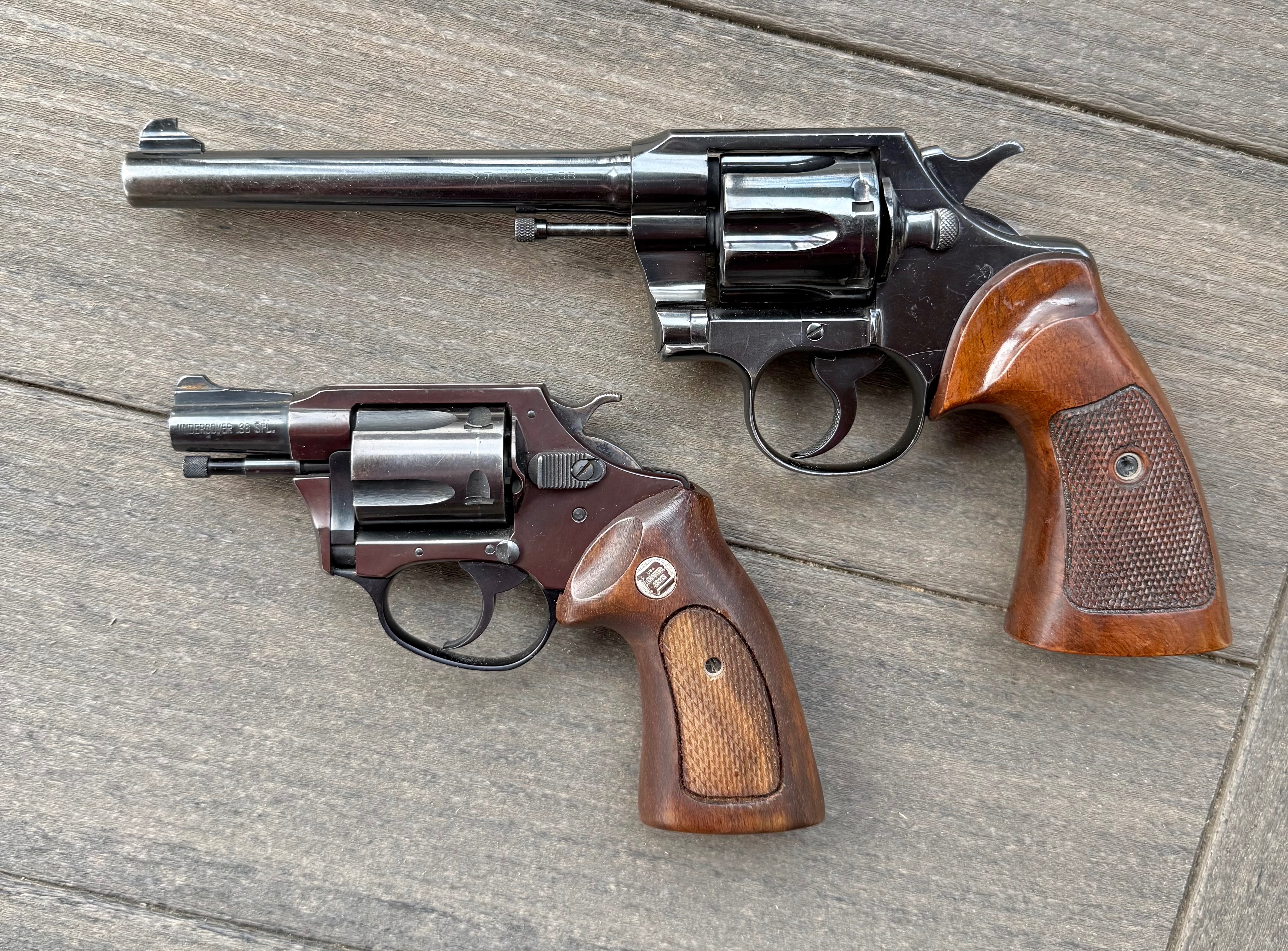

October 17, 2017
Offline

Hmmm. Perhaps some of you may have scoffed at my claim of accuracy from a snub nose revolver. Douglas McClennahan had done design work for both Sturm, Ruger & Co., Inc. and Colt’s Patent Firearms Manufacturing Company before going out on his own to found Charter Arms in 1964. From Ruger he borrowed a one piece frame (eliminating a side plate) for added strength, and from Colt’s he achieved nearly bank vault lockup, yet with fewer parts. The cylinder rotates clockwise, and the bolt cuts are heavily offset like a Colt giving added cylinder strength. Wikipedia erroneously claims that the 8 groove barrel was added later, but actually all Charter Arms revolvers always had the 1 in 16 inch twist 8 groove barrel. In full lockup (trigger all the way back) the cylinder will barely move in any direction and is in perfect alignment with the bore. This is perhaps the most important design aspect to revolver accuracy, and the Pre-War Colt also pictured behaves in exactly the same manner. Barrel length in itself is meaningless with regard to accuracy. As long as the twist rate is adequate for the weight of the projectile maximum accuracy will be achieved. Velocity loss will affect trajectory with regard to elevation, but that’s all. For fun, I actually tried my hand at an informal IHMSA match with the Undercover. I toppled the first five chickens; a feat that I don’t always necessarily achieve with my DW’s. Didn’t do as well on the other five, but it sure was fun trying.


1 Guest(s)
